What is
NDVI?
NDVI (Normalized Difference Vegetation Index) and NDRE (Normalized Difference Red Edge) both let you see vine health from above — but they read different things. Like judging a vine by leaf colour and canopy density, not just one.
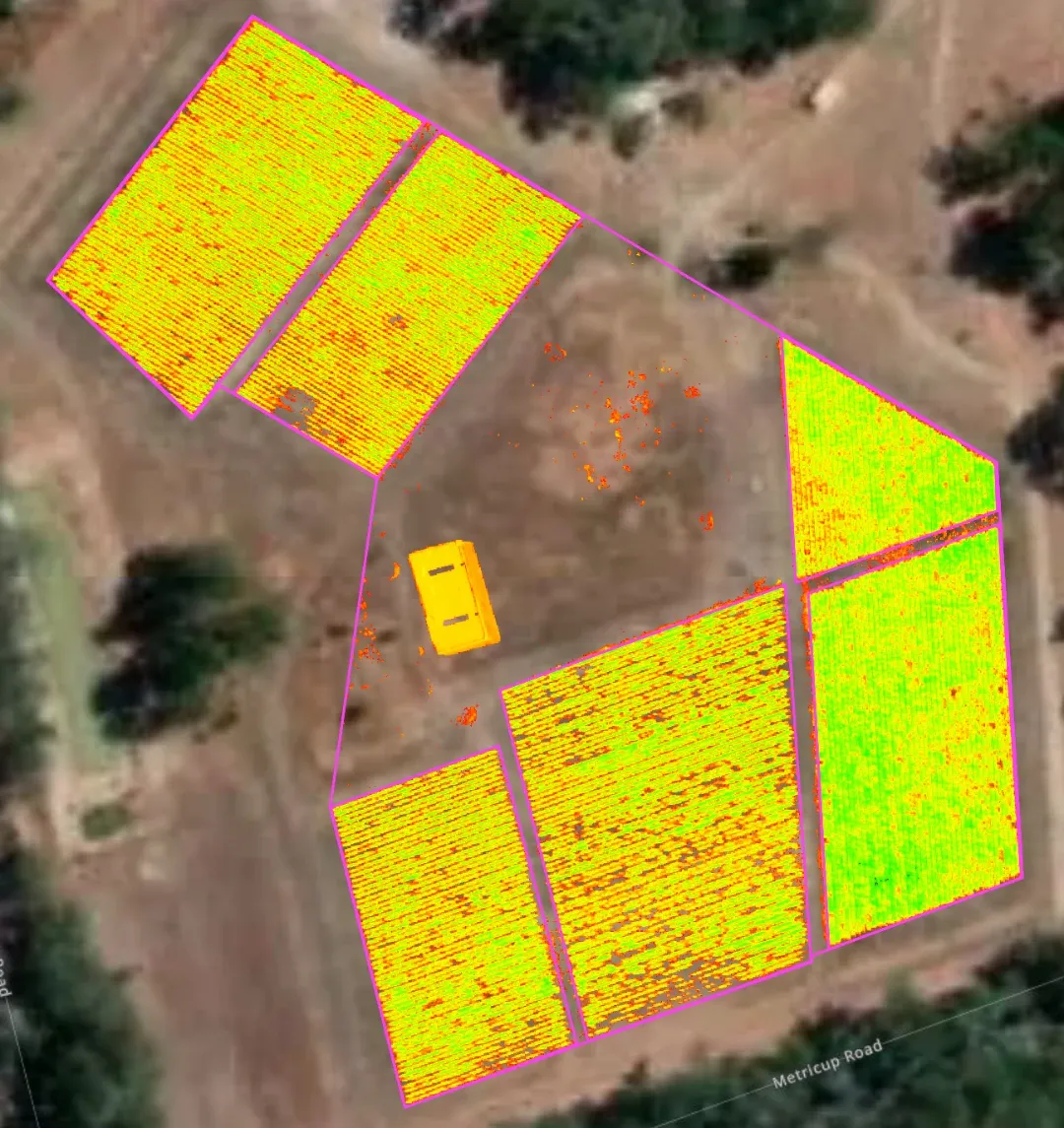
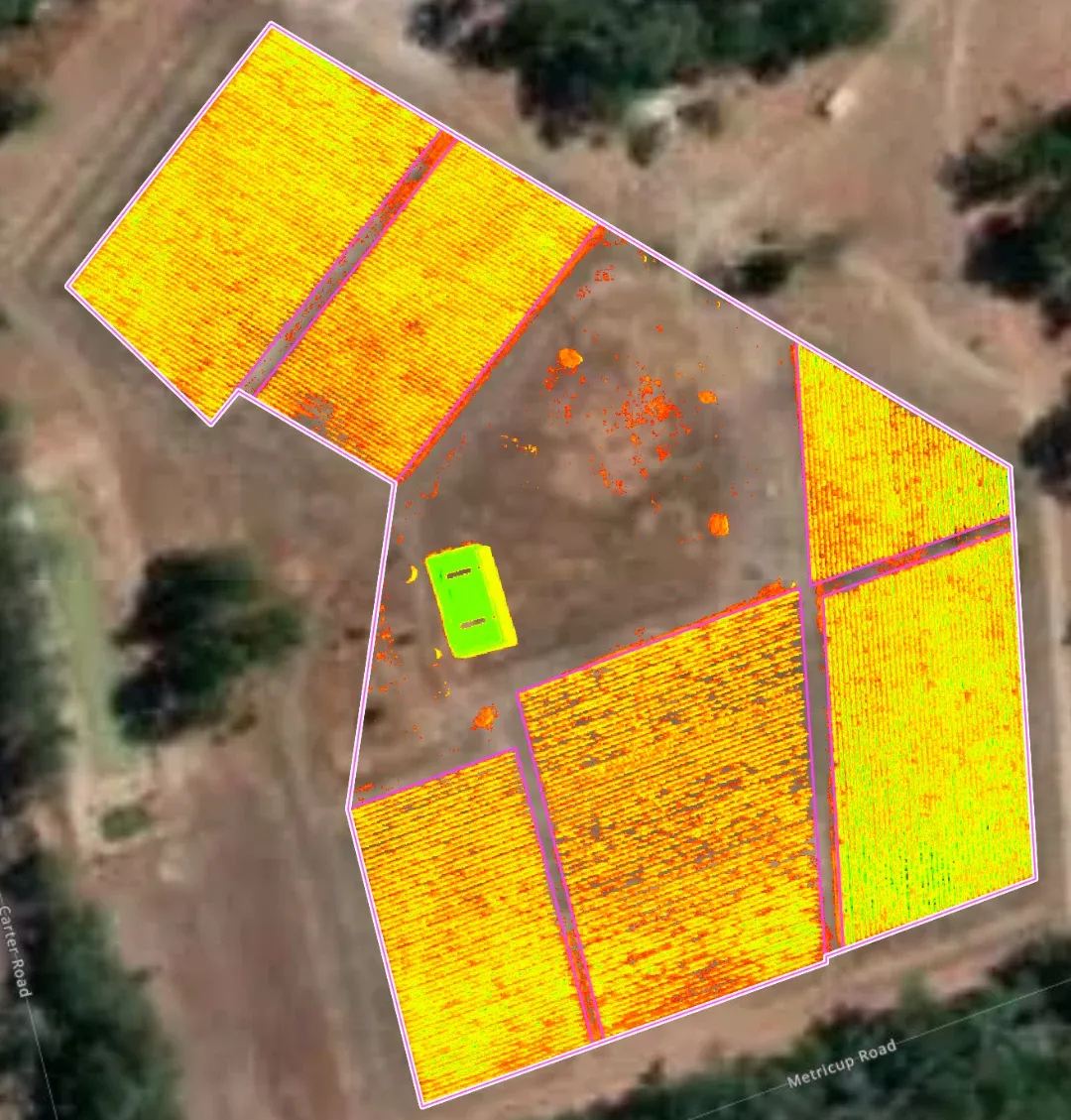
One sees the big
picture. One sees deeper.
They're not rivals — most vineyard managers use both. NDVI for the broad strokes and early planning, NDRE for precision when it counts toward harvest quality.
The vigour map.
Measures the difference between red and near-infrared light your vines reflect — a read on overall canopy density and biomass.
- What it tells you
- Overall vigour and biomass. Healthy, chlorophyll-rich vines reflect strong near-infrared and read high.
- Best season
- Early to mid-season — mapping vigour, finding weak patches, checking canopy establishment.
- The catch
- Saturates once the canopy gets dense — everything reads "green" even when there are real differences underneath.
The precision check.
Uses the "red edge" band — a narrow slice of light where vegetation reflection changes fast — to look deeper into the canopy.
- What it tells you
- Chlorophyll content and nitrogen status, accurately, even in a full canopy.
- Best season
- Mid to late season — subtle stress NDVI misses: early nutrient gaps, water stress, disease pressure.
- The advantage
- Doesn't saturate — it tells "healthy" from "very healthy", and flags problems earlier.
When each earns
its keep.
Through a Margaret River growing season, the useful index shifts from NDVI to NDRE as the canopy fills in. Here's roughly how they trade off, bud break to harvest.
Early on, an open canopy makes NDVI the better read on vigour. As the canopy closes, NDVI saturates and NDRE takes over — most useful through veraison and into harvest, when fruit quality and water status matter most.
Which one, and when.
- Build management zones from overall vigour patterns
- Spot problem areas early in the season
- Guide variable-rate fertiliser in spring
- Assess vine establishment in young blocks
- Fine-tune nitrogen in mature blocks
- Catch water stress before it's visible
- Monitor health through veraison into harvest
- Pick up disease or pest pressure in its early stages
NDVI checks your vines are green and growing. NDRE checks they're truly thriving — with the nutrition to make quality fruit.
You wouldn't judge a vine by trunk diameter alone, ignoring leaf colour and fruit set. The two indices complement each other all season — and the smartest programs use both.
We capture both —
and hand you the map.
We fly your blocks in NDVI and NDRE, build the zones, and deliver them as a field app you can walk. Curious what your season looks like from above?